A study of how trust is built through user interaction with AI interfaces and the design challenges that emerge from those interactions.
Trust
in AI
Interfaces

Inside this chapter
Five AI interfaces, each analysed across function, interaction, trust challenges, and a proposed redesign.
The experiential dimensions of trust
This document presents the practical exploration and documentation phase of the research. It focuses on the analysis and redesign of five AI-driven interfaces in different categories of AI systems. Spotify as a recommendation system, Grammarly as a generative AI system, Google Maps as a predictive and decision-support system, ChatGPT as an AI assistant, and Amazon as a safety, security, and fraud detection AI system.
The purpose of this chapter is to answer how trust is built through user interaction with AI interfaces and to identify the design challenges that emerge from these interactions. Each case study represents a different form of AI behavior and interaction pattern.
This chapter focuses on the experiential and interactional dimensions of trust in AI interfaces. The proposed redesign concepts investigate how design can mediate the relationship between users and intelligent systems.
Spotify
Introduction & rationale for selection
Spotify was selected as a representative case of an AI-driven recommendation system. As a platform, Spotify continuously adapts its content based on user behavior, and it is a great example of how algorithmic systems influence everyday decision-making processes.
Spotify's recommendations directly shape users' listening habits, which makes it a relevant case for examining issues of transparency, control, and trust in AI interfaces. Its widespread use and personalization features make it a suitable case study within this research.

Function of the AI system
The AI system in Spotify, as a recommendation engine, has been designed to predict user preferences and suggest relevant content. The system first analyzes patterns in user behavior and compares them with broader listening trends, aiming to create a personalized and engaging experience.
Eventually, it determines which songs, artists, or playlists a user is most likely to enjoy, so the effort required for content discovery is reduced, and user engagement increases.
System operation
Spotify's recommendation system uses multiple data sources and machine learning techniques. User behavior data forms the foundation of its predictions, while contextual information completes them. Collaborative filtering identifies users with similar preferences, and content-based analysis evaluates audio features. These mixed inputs are processed by machine learning models to generate dynamic, personalized recommendations.
Points of user interaction
The AI shapes experience by selecting and organizing content at each of these touchpoints.
Trust issues in the system
Design interventions & proposed solutions


Clarifying playlist recommendations


Spotify shows how AI recommendation systems can improve experience through personalization, yet face real challenges of transparency, control, and trust. Explainable, user-centered design aligns the system with user expectations and fosters a more trustworthy interaction.
Grammarly
Introduction & rationale for selection
Grammarly was selected as an example of a generative AI interface for its ability to produce, modify, and enhance user-generated text. It directly intervenes in the writing process to offer alternative phrases, adjust tone, and improve clarity.
This makes it a compelling case for observing how users interact with AI. Features like rewriting and tone adaptation raise important questions around authorship, control, and trust in AI-assisted communication.
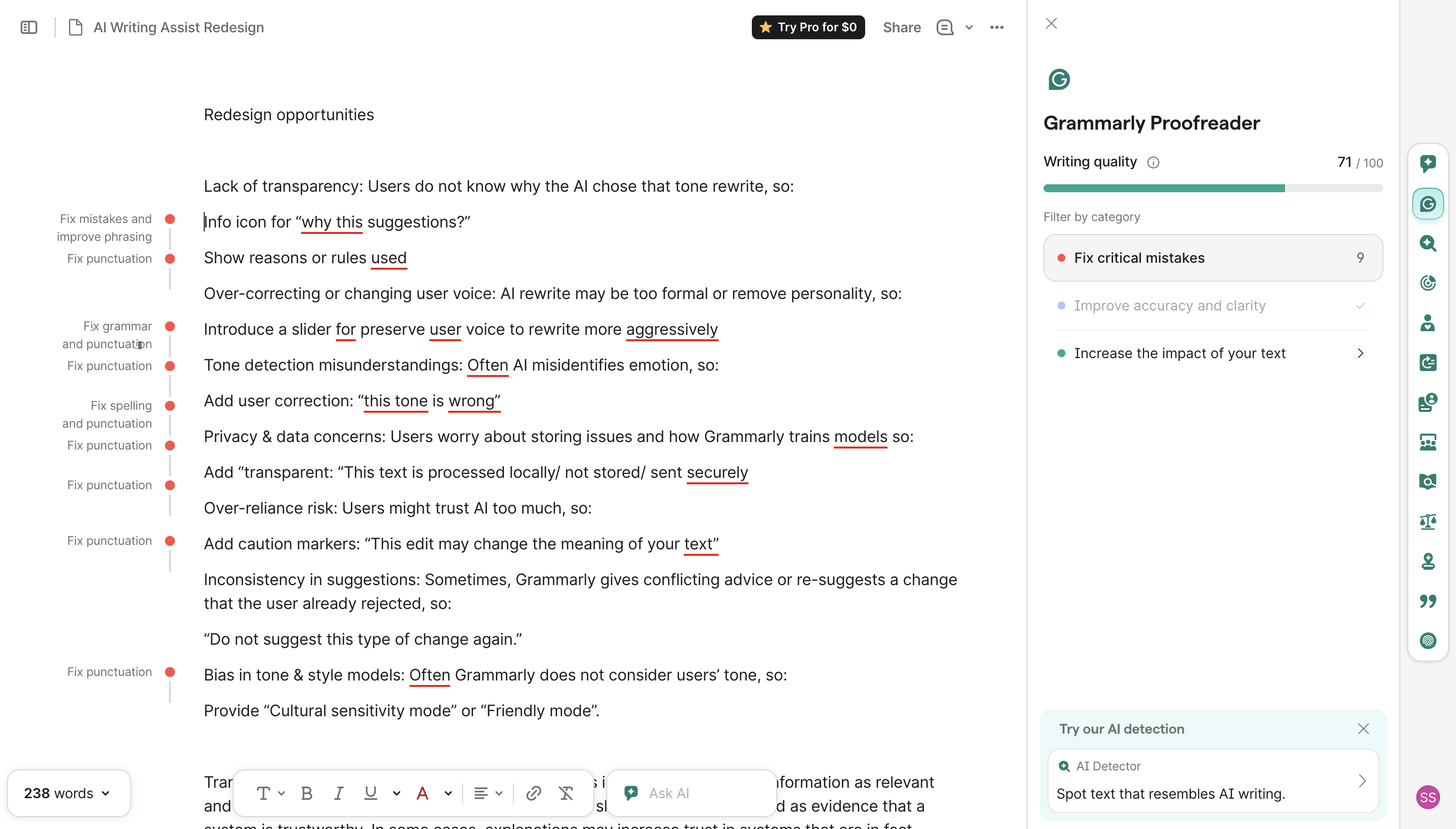
Function of the AI system
As a generative and assistive language model, Grammarly analyzes written text and produces suggestions to improve grammar, clarity, tone, and style. Its primary goal is to enhance communication by making text more effective and appropriate.
Beyond correcting errors, the system generates alternative expressions and tone variations — actively participating in how a message is shaped rather than only flagging mistakes.
System operation
Grammarly operates through a combination of linguistic analysis and machine learning models. It processes the input text, considers the immediate context of sentences, and identifies writing patterns. Statistical language models evaluate grammatical correctness, coherence, and stylistic appropriateness, while tone preferences are used to align suggestions with the user's intentions.
Points of user interaction
At each point the AI evaluates input and proposes modifications, making itself visible and interactive.
Trust issues in the system
Design interventions & proposed solutions
Each intervention is shown as a before-and-after of the live Grammarly interface.
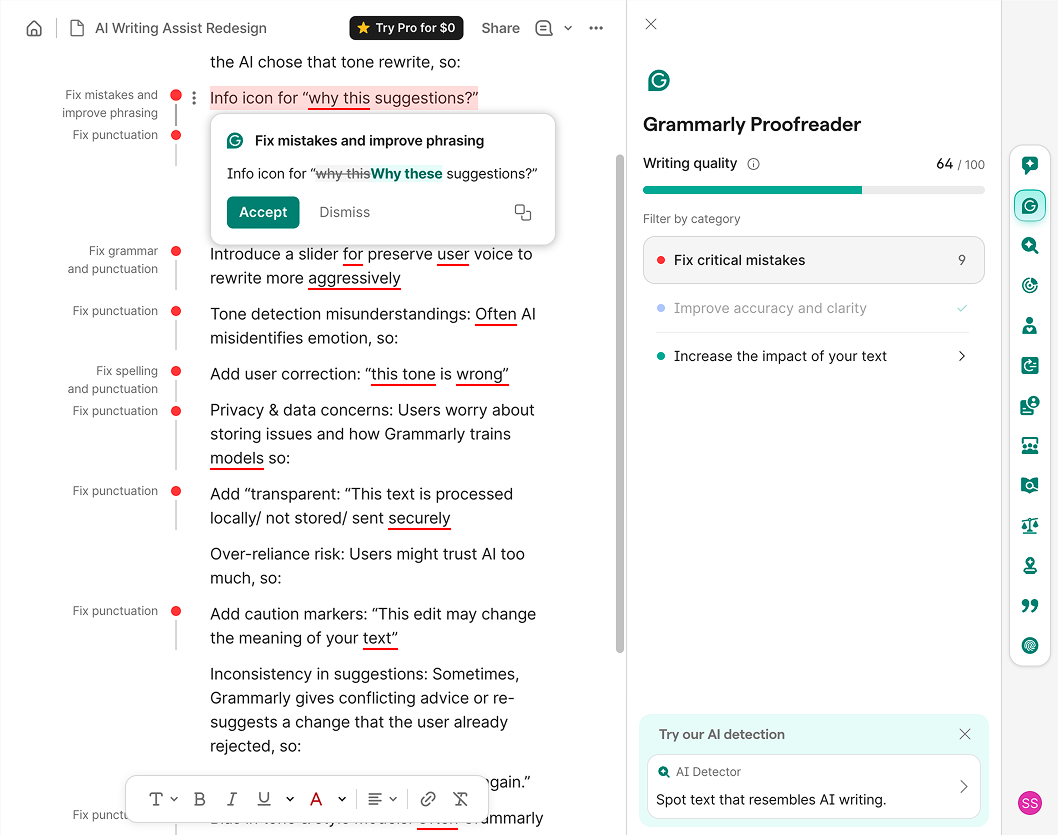
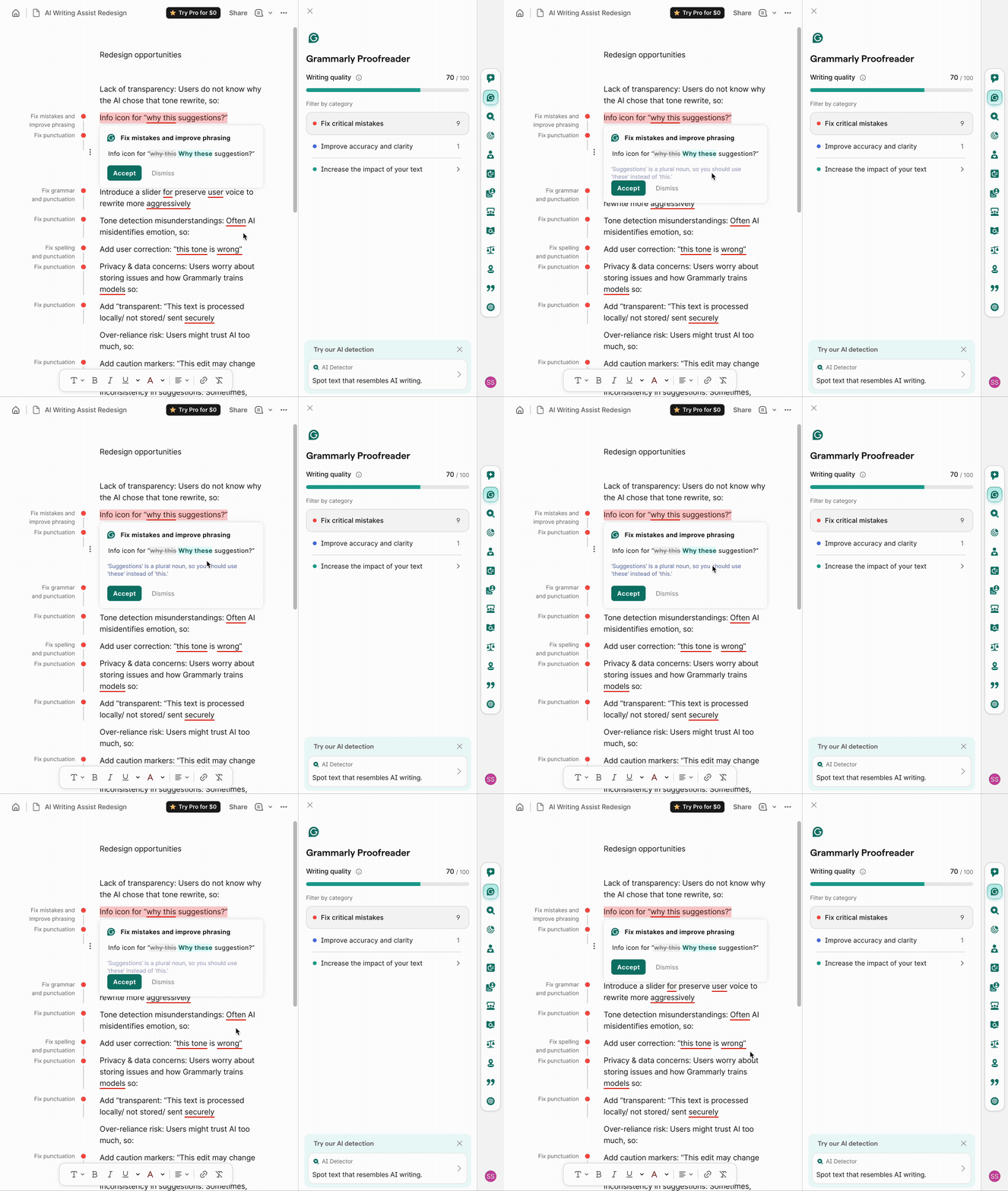
Design interventions & proposed solutions
Each intervention is shown as a before-and-after of the live Grammarly interface.
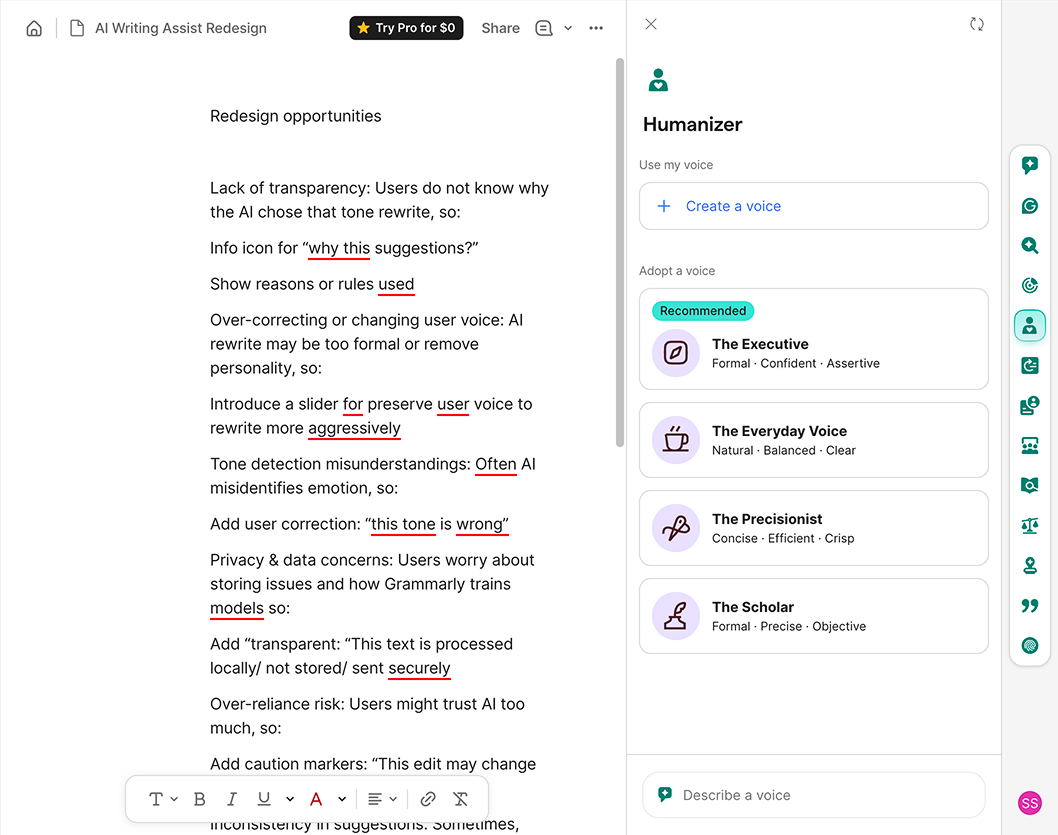
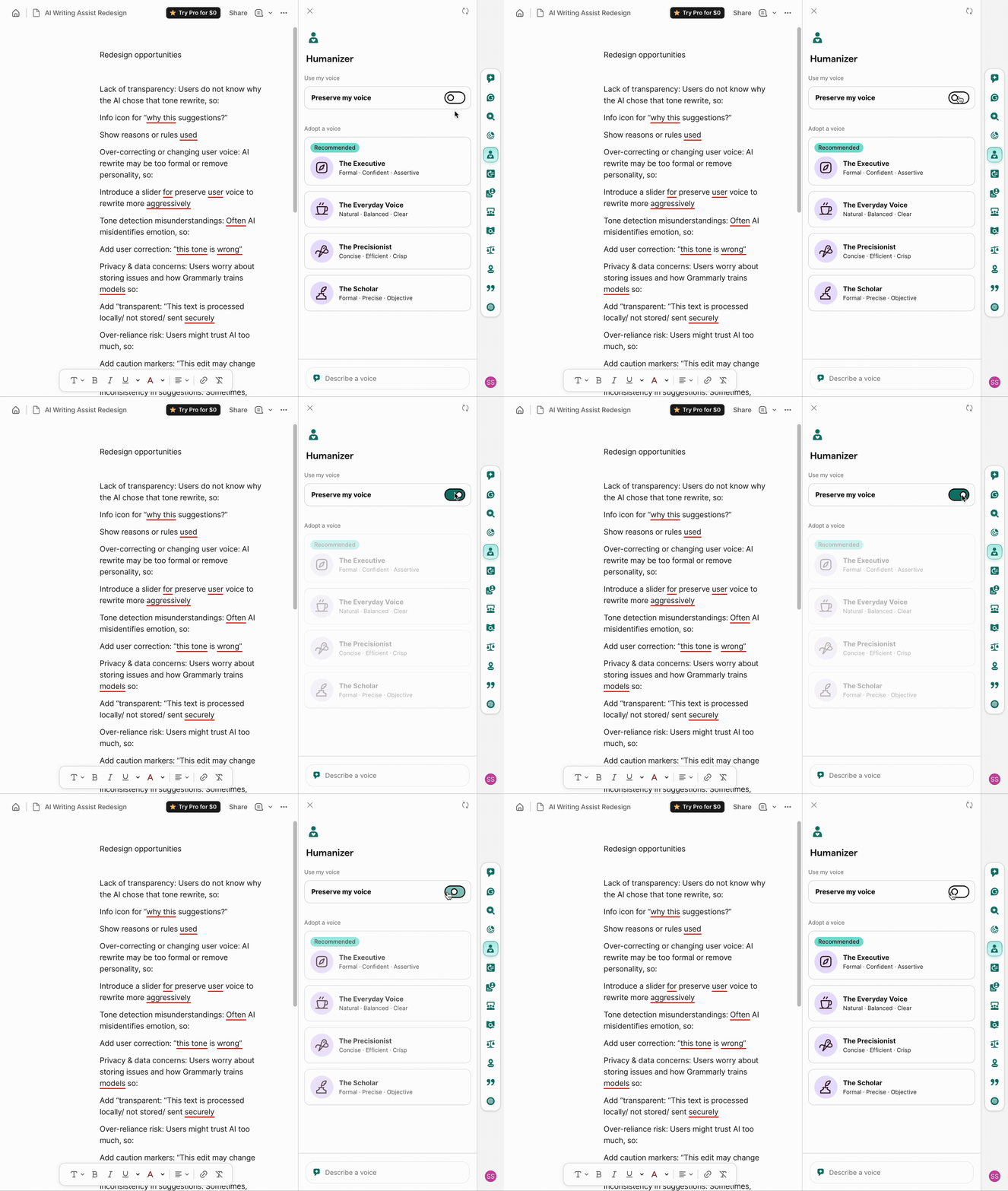
Design interventions & proposed solutions
Each intervention is shown as a before-and-after of the live Grammarly interface.
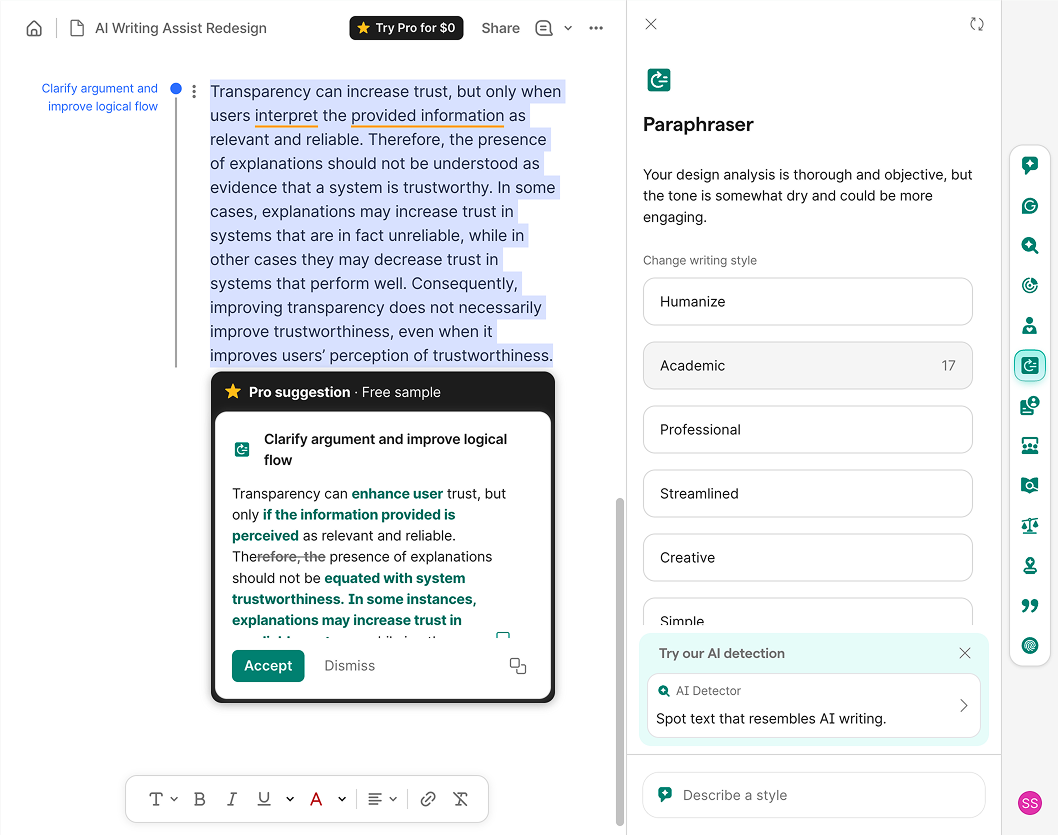
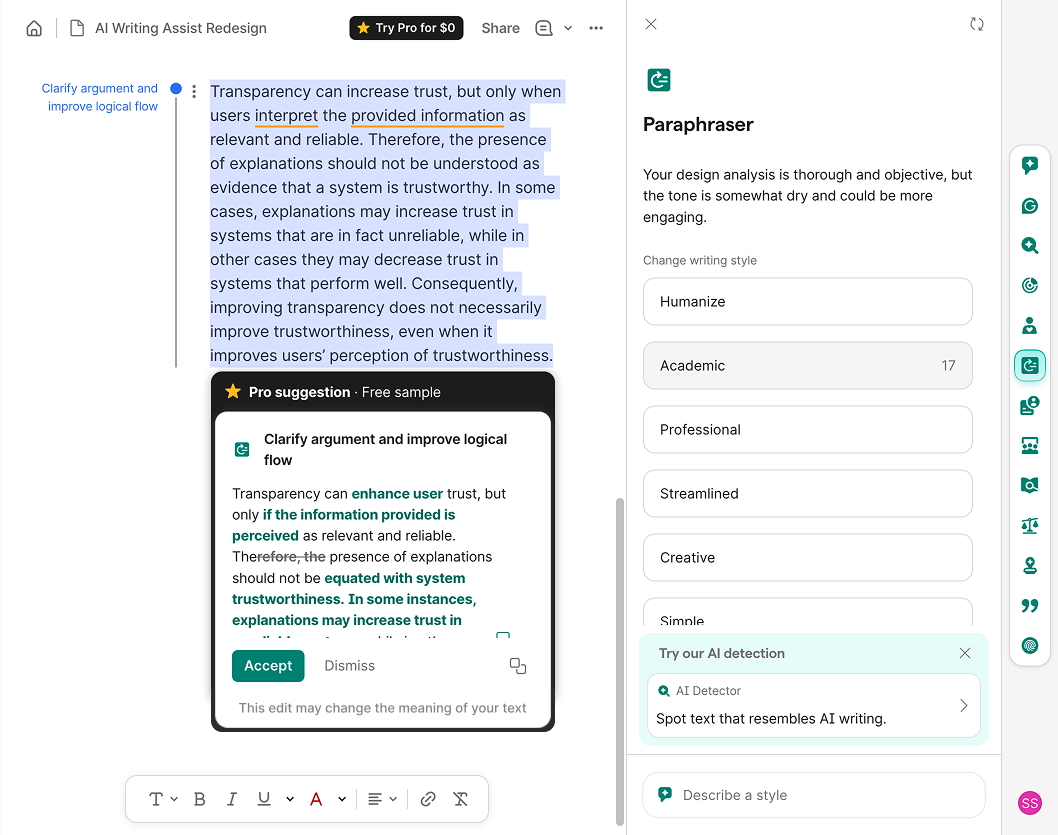
Design interventions & proposed solutions
Each intervention is shown as a before-and-after of the live Grammarly interface.
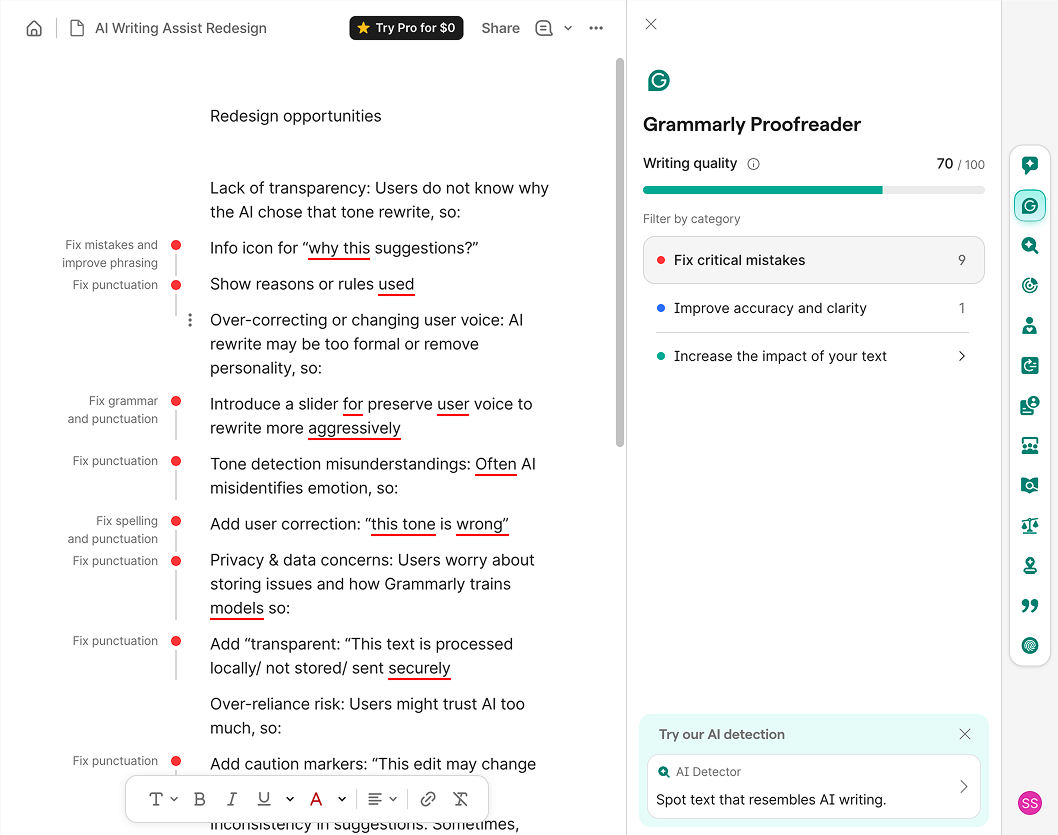
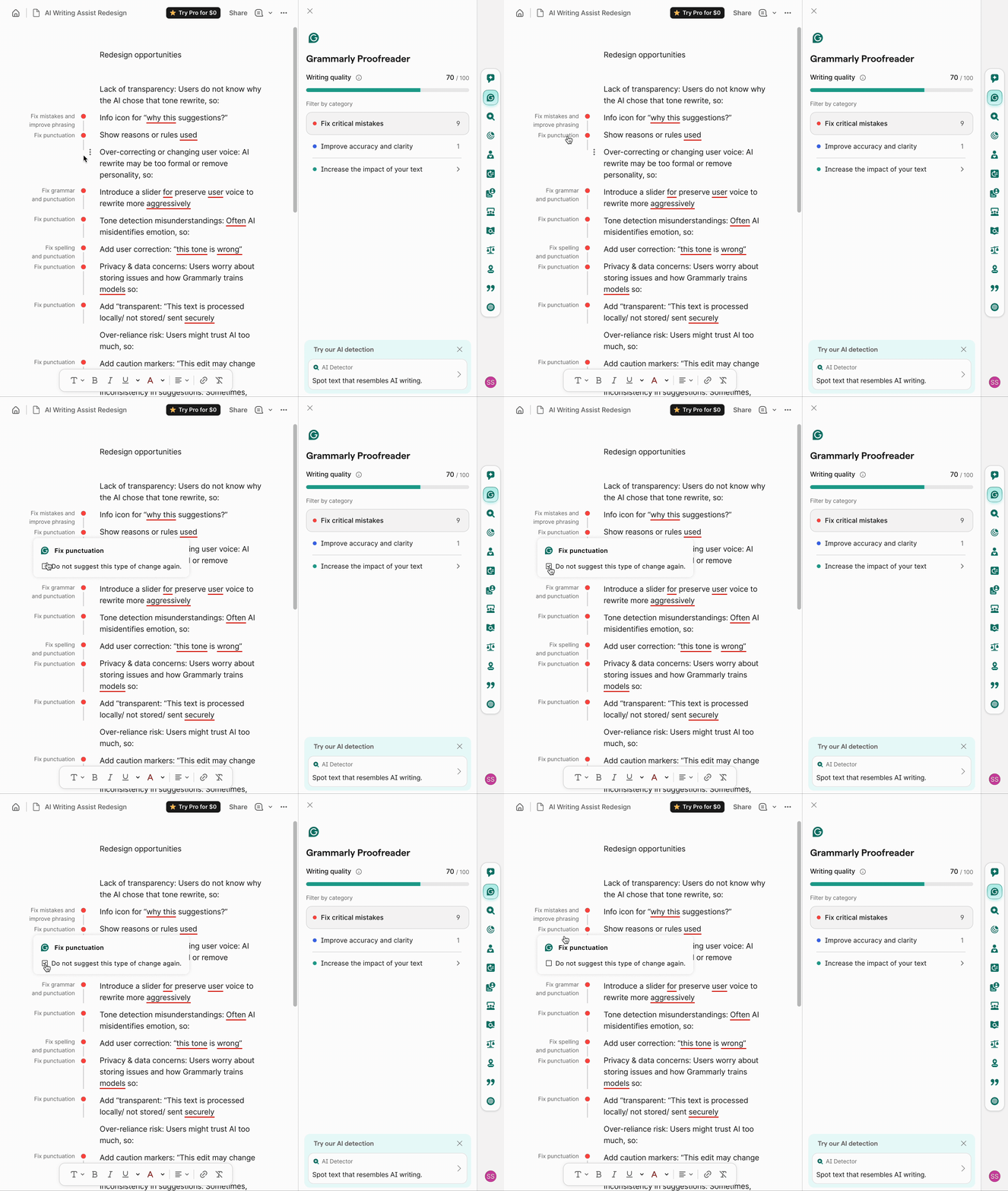
Grammarly demonstrates how generative AI can actively participate in content creation. It enhances efficiency and quality, but raises concerns of transparency, authorship, and control. Explainable and customizable design strategies can foster a better, trust-based interaction.
Google Maps
Introduction & rationale for selection
Google Maps was chosen as a predictive and decision-support system for its ability to process large-scale real-time data and provide actionable navigation guidance. It supports users in making time-sensitive decisions such as route selection and travel planning.
Built on dynamic data and predictive modeling, it is a critical choice for examining how AI adapts to changing conditions and how it earns trust in real-world contexts.

Function of the AI system
The AI system in Google Maps estimates travel conditions and recommends optimal routes. Its goal is to help users reach their destinations by predicting traffic patterns and estimating arrival times.
Crucially, it adapts routes as conditions change in real time, responding to the live state of the road network rather than relying on a single fixed plan.
System operation
Predictive models analyze a large volume of data to estimate travel time and traffic flow, then evaluate multiple route options and recommend the most efficient one. The output appears as route suggestions, arrival-time estimation, and dynamic updates during navigation. If conditions change, the system recalculates and adjusts its recommendations in real time.
Points of user interaction
Users meet the AI wherever predictions surface and the route responds to new data.
Trust issues in the system
Design interventions & proposed solutions
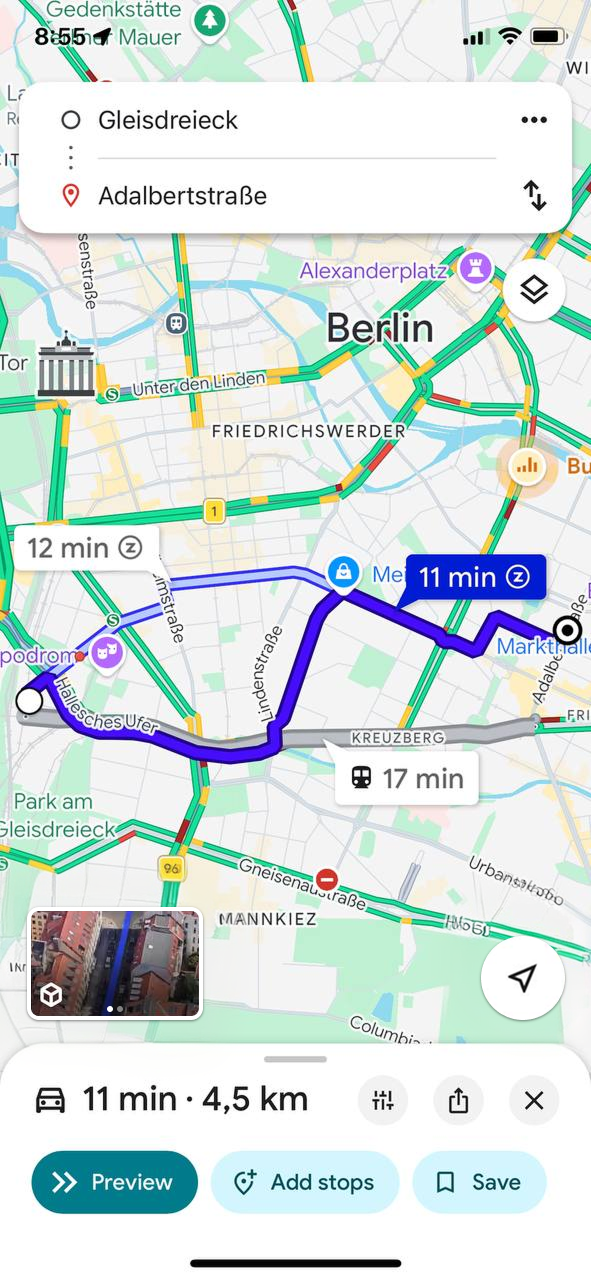
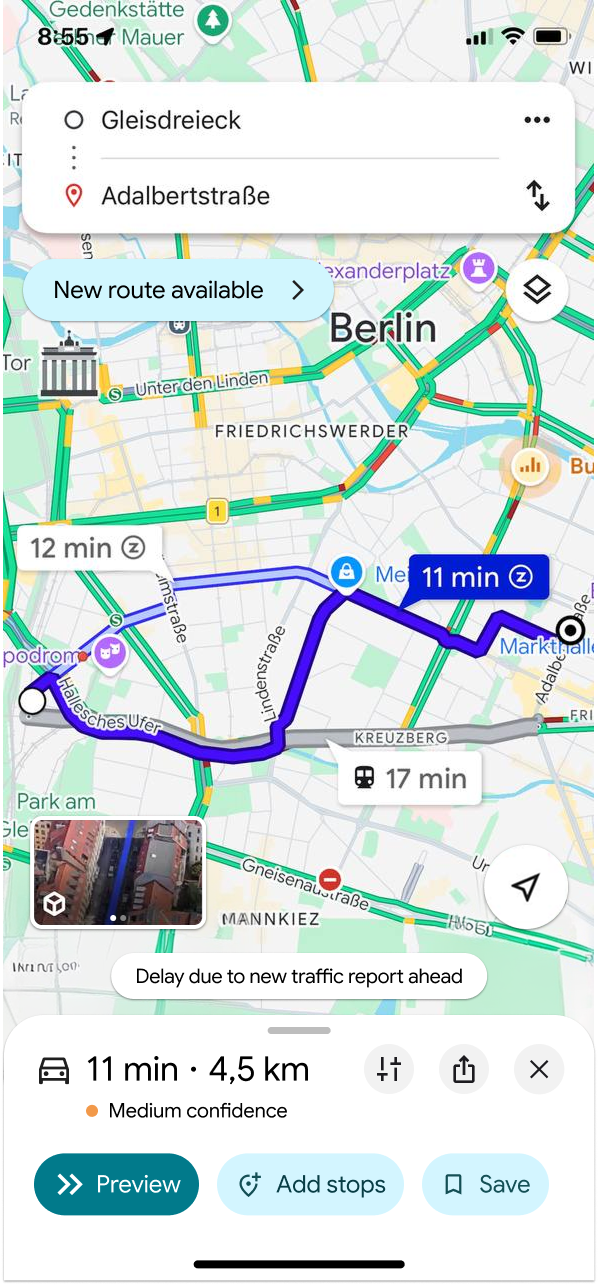
Each intervention is shown as a before-and-after of the live Google Maps interface.
Design interventions & proposed solutions
Each intervention is shown as a before-and-after of the live Google Maps interface.
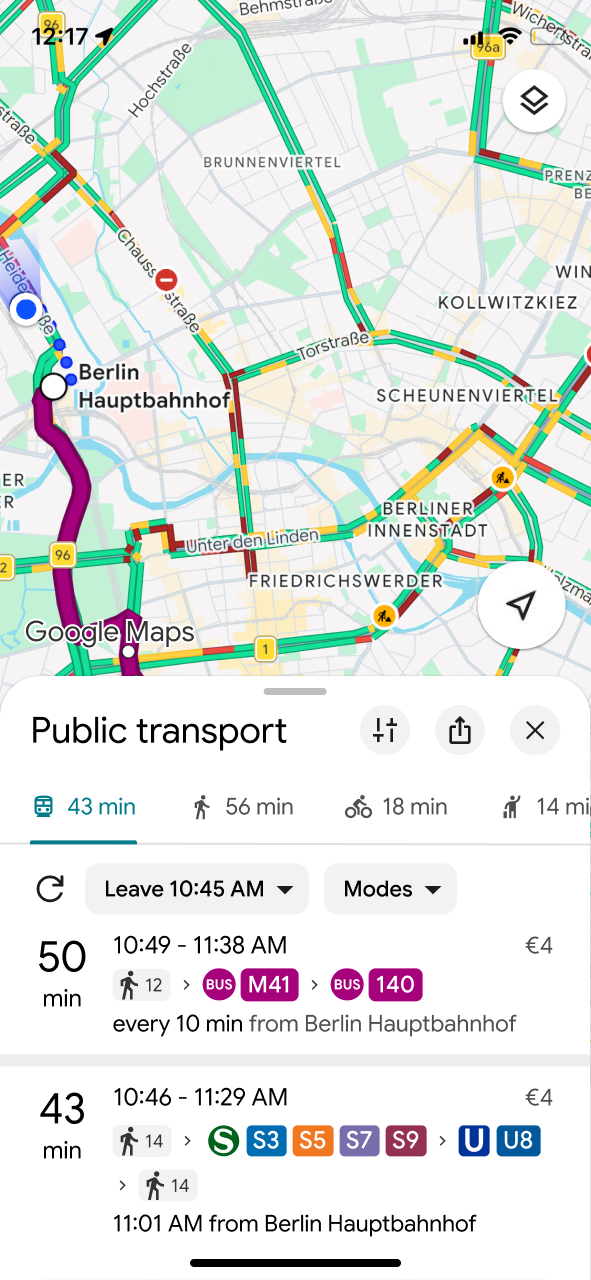
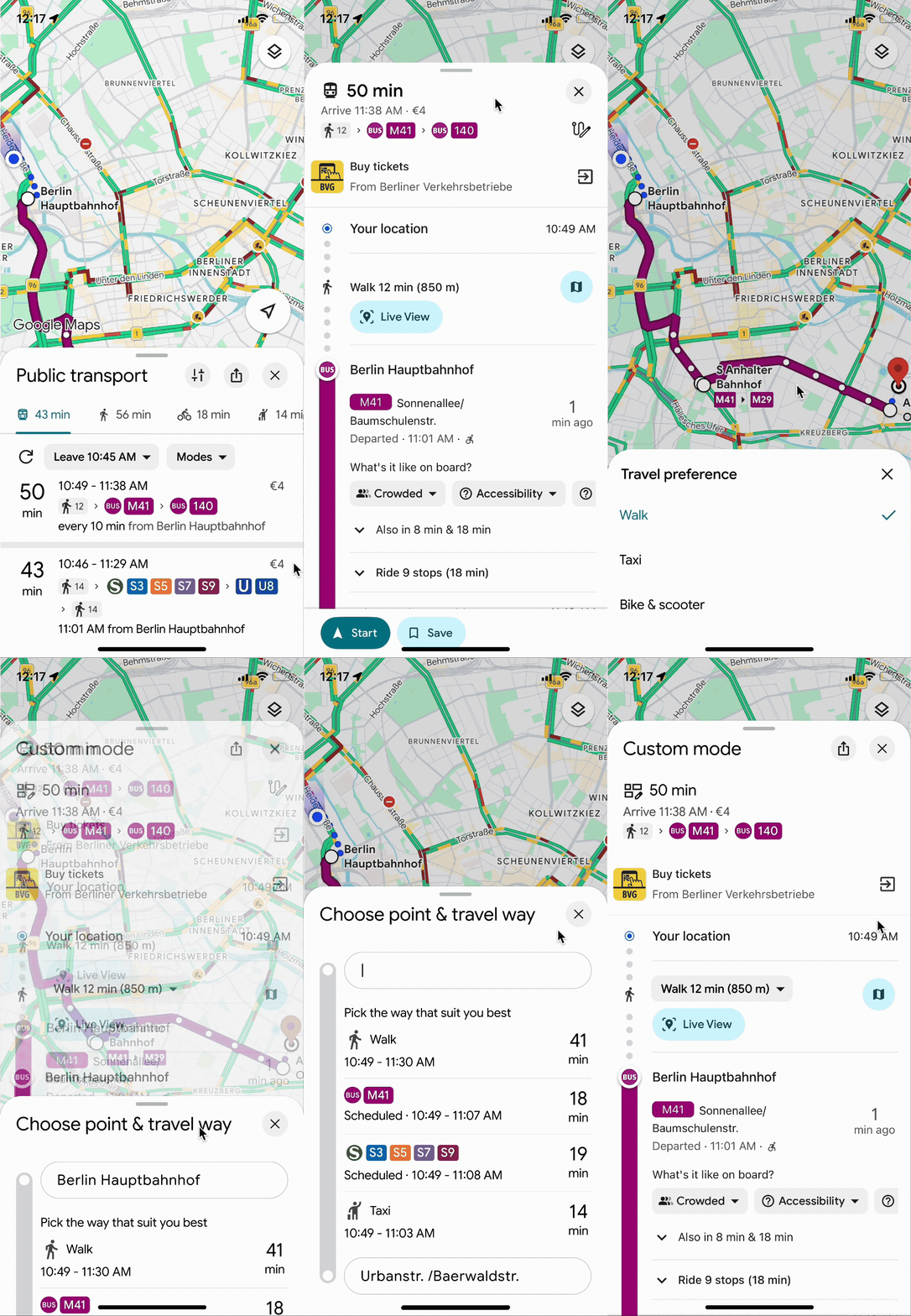
Google Maps illustrates how a predictive AI system analyzes and responds to dynamic data. Challenges of transparency, control, and uncertainty can undermine trust — explainable predictions and clearer communication align the system with what users expect.
ChatGPT
Introduction & rationale for selection
ChatGPT was selected as an AI assistant because it provides direct conversational interaction between users and artificial intelligence. AI reasoning and response generation sit at the center of the experience, and interactions are shaped by the system's ability to interpret input and generate relevant responses.
This makes it valuable for analyzing trust: users constantly evaluate the reliability, transparency, and accuracy of generated information. Because conversational AI presents information confidently, trust-related challenges become highly visible.
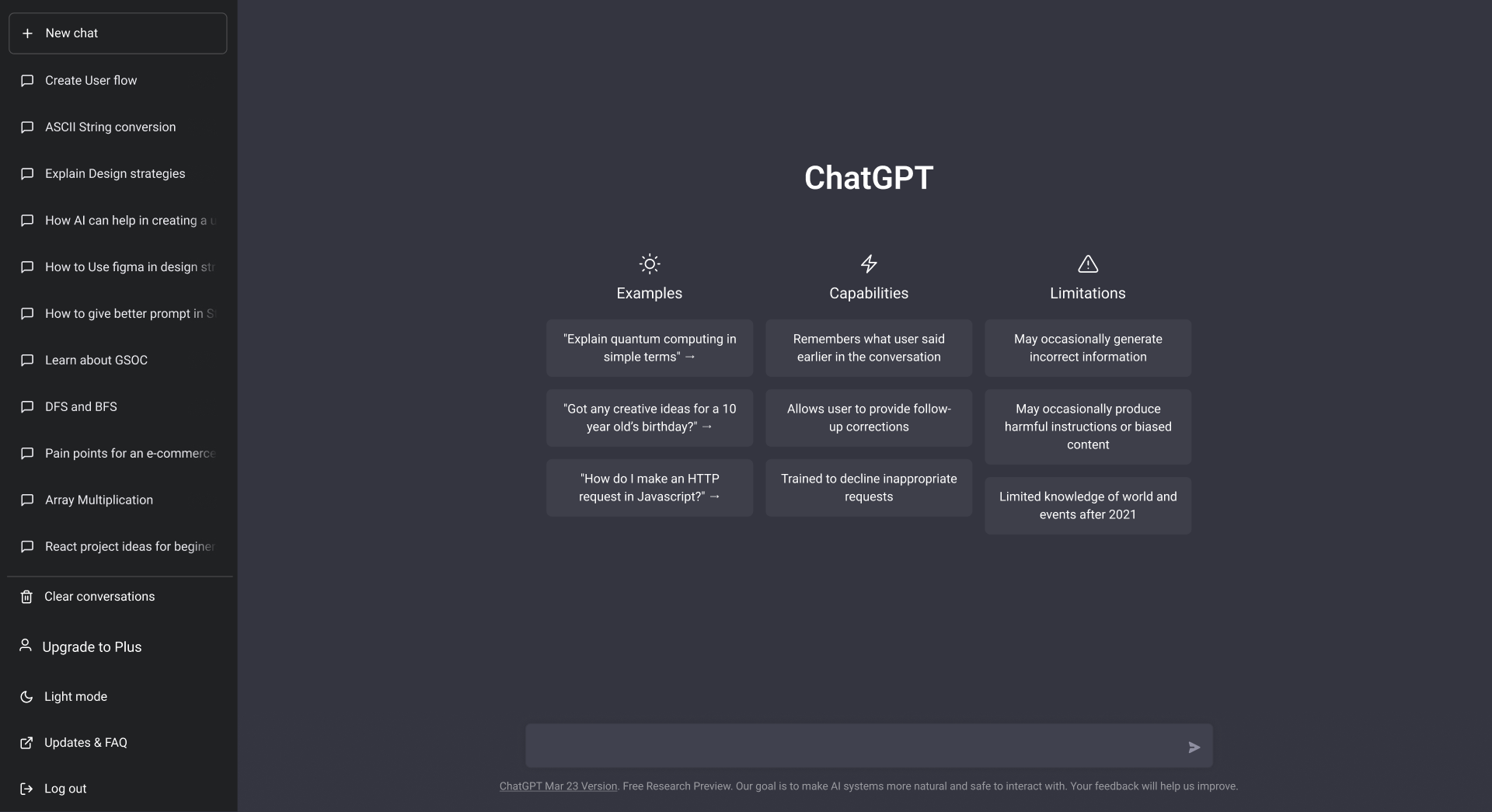
Function of the AI system
ChatGPT is designed to interpret user prompts and generate natural-language responses. It works as a general-purpose assistant rather than a single-task tool.
Its primary goals are answering questions, providing explanations, assisting with writing, brainstorming ideas, and solving problems.
System operation
ChatGPT operates using large language models trained on extensive text datasets. When a user writes a prompt, the system analyzes the input to identify context, intent, and relevant linguistic patterns, then predicts the probable words to generate a coherent response. It does not retrieve information like a search engine; it generates responses from learned statistical relationships between words, concepts, and contexts, while considering the current conversation history.
Points of user interaction
Users encounter AI throughout every part of the interface — most directly in the chat itself.
Trust problems in the system
Design interventions & proposed solutions


ChatGPT creates fluent, human-like interactions, but that fluency introduces overconfidence, opacity, hallucination, and over-reliance. The interventions build trust through explainability, communicating uncertainty, and greater user control.
Amazon
Introduction & rationale for selection
Amazon is a strong example of safety, security, and fraud-detection AI because it relies on algorithmic systems to manage trust and credibility. Its AI infrastructure evaluates risks, detects suspicious behavior, and regulates marketplace reliability. Purchasing decisions usually depend on ratings, reviews, and trust labels.
These AI systems operate as invisible moderators that shape experience through filtering, ranking, and credibility assessment. This makes the platform relevant for assessing transparency, interpretability, and trust.

Function of the AI system
The AI system in Amazon analyzes user activity, reviews, transactions, and seller behavior to maintain reliability across the marketplace.
Its goal is to identify suspicious patterns, reduce manipulation, and support trustworthy interactions between buyers and sellers.
System operation
The platform gathers data on transactions, review activity, purchasing behavior, seller performance, and account interactions, then analyzes it to identify patterns of manipulation or fraud. Through risk scoring, the system evaluates the probability of unreliability for certain reviews, sellers, or transactions, and may automatically filter reviews, verify accounts, restrict sellers, or raise security alerts. In higher-risk situations, the case is flagged for a human moderator's review.
Points of user interaction
Many of the system's operations run in the background, quietly influencing perception and decision-making.
Trust issues in the system
Design interventions & proposed solutions
Each intervention is shown as a before-and-after of the live Amazon interface.


Design interventions & proposed solutions
Each intervention is shown as a before-and-after of the live Amazon interface.


Amazon shows how AI-driven moderation and fraud detection shape trust. A lack of communication and transparency breeds uncertainty and makes AI-driven evaluations understandable and visible, fostering a more trustworthy relationship.